
BMW Sauber F1
Technical analysis of BMW Sauber F1.08 Evolution
By BMW Sauber F1
November 13 2008
There is a rule of thumb in Formula 1: Standing still means going backwards. Vehicles change from race to race. The engineers are continually modifying the vehicles depending on the characteristics of the different circuits – the extremely long straights in Monza require a different aero package than the tight and slowcorners in Monaco.
Willy Rampf, the Technical Director of the BMW Sauber F1 Team, uses aselection of technical drawings to describe the constant change undergone by the BMWSauber F1.08.
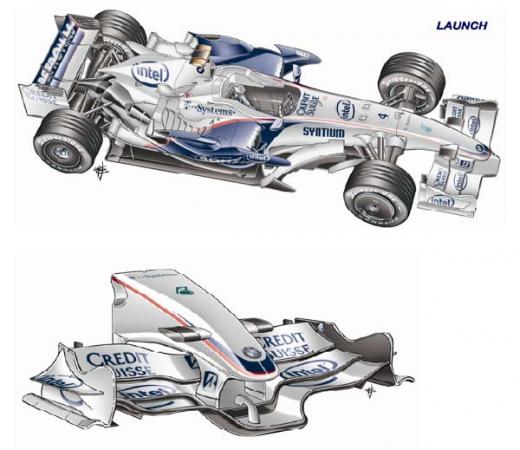
BMW Sauber F1.08, Car Launch, Munich, January 2008.

Willy Rampf: “The elimination of traction control meant that the cars would be more difficult to drive. Our goal was therefore to build a stable car with precise feedback at the front axle and lots of grip at the rear axle, in order to make the driver’s job easier. As far as aerodynamic efficiency was concerned, we wanted to take a significant step forward by comparison with the F1.07. We were able to achieve this objective by a number of measures including a special, compact engine cover. We opted for a very dominant front wing, the great potential of which allowed us to compensate for the entire range of different weight distributions. The vent chimneys combined with the lamellar outlet vents to permit good cooling without significant disadvantages for aerodynamics even under extreme conditions. By contrast with the rim covers, the Tomcat wings on the car’s nose and the vertical sidepod reflectors were not fitted to the car for the presentation.”
BMW Sauber F1.08, Melbourne, March 2008.

Willy Rampf: “We optimised lots of details in the car during extensive winter tests and hence made good progress. However, only some of these modifications were visible. The newly mounted Tomcat wings influenced the air flow round the cockpit and therefore improved the aerodynamics at the rear end. The vertical sidepod reflectors calmed the air turbulence around the front wheels and ensured maximally harmonious flow of air along the sidepods. The underbody benefited from this, in particular the diffuser. A minor modification to the tuning vane was also working towards the same goal. The monocoque wing conducted the air flow downwards, particularly from the mid-section of the front wing. The rim covers were not used in Melbourne because they changed the balance of the vehicle in a way that did not match the characteristics of this circuit.”
Continues at http://www.f1network.net/main/s491/st136093.htm
 Digg
Digg Delicious
 Facebook
 Reddit
 Stumbleupon

More BMW Sauber F1 headlines
BMW Sauber F1 latest threads
- apper
- New Topic--->Click Here Priz+Bonus
- Buy tramadol without a prescription, Cheap tramadol for sale. Order tramadol online
- Buy online without a prescription, Cheap prandin for sale. Order prandin
- prescription or membership Plendil
- GOOD TO SEE SAUBER'S BACK
- Sergio Perez's withdrawal from Canada
- Turkey Qualifying 2011
- Turkey, 2011
- Kobayashi gets a point in China for Sauber